
There’s a particular kind of cognitive dissonance that sets in when you watch a professional carpet cleaner pack up their equipment, survey your freshly restored floors, and hand over an invoice. The carpets look extraordinary – genuinely, almost offensively clean, the kind of clean that makes you notice every other surface in the room by comparison – and somewhere in the back of your mind, a quiet internal voice asks: how long before it looks like this again?
The honest answer depends almost entirely on what you do between now and the next time someone with a professional-grade machine crosses your threshold. Professional cleaning isn’t a reset button that gives you permission to go back to whatever habits wore the carpet down in the first place. It’s more like a service on a car – enormously worthwhile, but only as part of a broader approach to maintenance that keeps the thing running well in between. The Londoners who get the most value from professional carpet cleaning are almost never the ones who book most frequently. They’re the ones who’ve learned to look after their carpets properly between visits and genuinely extend the intervals as a result.
Here’s what that actually looks like in practice.
Know Your Enemy – What’s Really Damaging Your Carpet
Most people assume that visible stains are the primary threat to carpet longevity. Stains are certainly inconvenient and worth addressing promptly, but the thing that degrades carpets faster than almost anything else is something far less dramatic: dry soil.
Grit, dust, fine particles from London’s streets, and the general airborne debris of urban life settle into carpet pile constantly. Every footstep grinds those particles against the individual fibres, wearing them down from the inside like microscopic sandpaper. The fibres don’t break cleanly – they fray, split, and lose their structure, which is what creates that flattened, dull, slightly felted appearance that people often mistake for a carpet simply being old. In many cases, it isn’t age. It’s accumulated grit that was never properly removed.
This is why the maintenance habits that matter most aren’t the dramatic ones – it’s not about having a cupboard full of specialist products or knowing the precise chemical composition of every household stain. It’s about consistently removing dry soil before it has time to work its damage. Everything else follows from that.
The Hoovering Habit – Do It More Than You Think
How Often Is Often Enough?
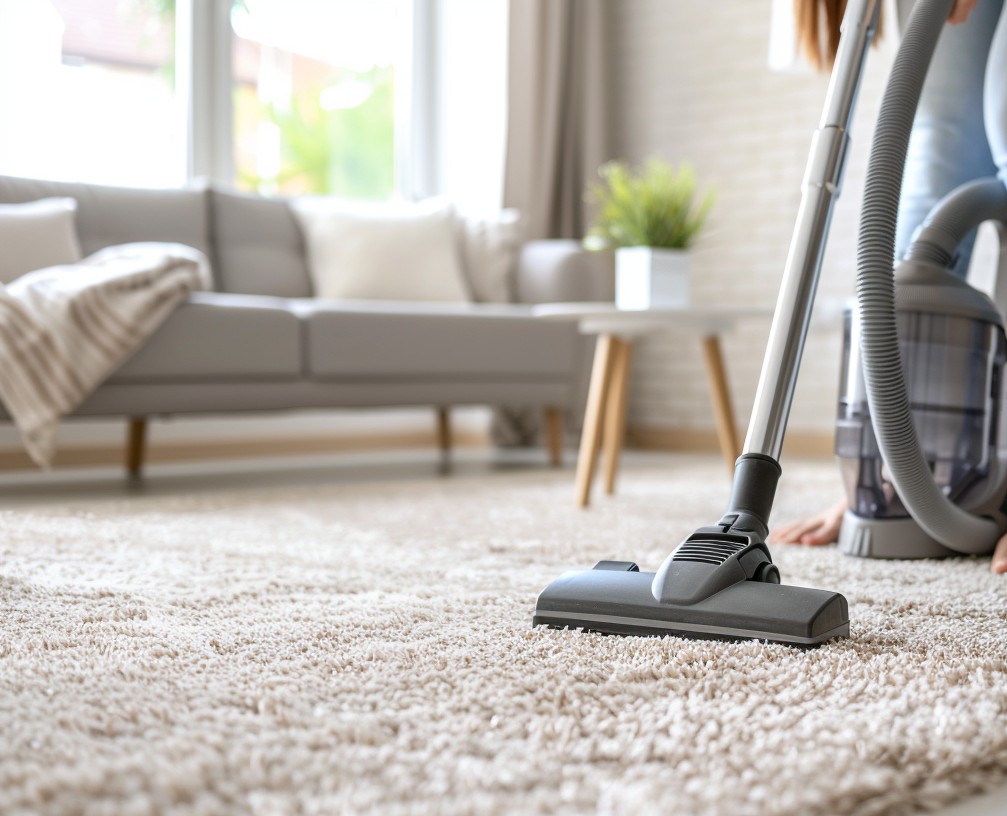
The standard advice to hoover once a week is a reasonable baseline for a lightly used room, but most London homes are not lightly used. If you have children, pets, a household of flatmates, or simply live in a ground-floor flat where the front door opens directly onto a busy street, once a week is the minimum – not the target.
High-traffic areas: hallways, the paths between door and sofa, the strip in front of the kitchen – benefit enormously from being hoovered three to four times a week. This sounds excessive until you consider that these are exactly the areas where grit is being ground in with every single pass. The carpet in a heavily-used hallway takes more abuse in a week than a bedroom carpet takes in a month. Treating them identically doesn’t make sense.
For rooms that see less daily traffic – a formal dining room, a spare bedroom – once a week or even once a fortnight is genuinely sufficient. The goal isn’t to hoover everything constantly for the sake of it. It’s to match the frequency to the actual footfall.
Technique Matters More Than You Think
A significant proportion of hoovering done in British homes is, politely speaking, not doing what the person doing it thinks it’s doing. A single quick pass over a carpet in one direction shifts surface debris but leaves the deeper-seated particles almost entirely undisturbed.
Effective hoovering means slow, overlapping passes – slow enough for the suction to actually draw material up from the base of the pile rather than skimming over the top. It means going against the direction of the pile as well as with it, particularly in high-traffic areas where the fibres have been pushed flat. It means not skipping the edges, where dust and grit accumulate along skirting boards in quantities that would genuinely surprise most people. And it means maintaining your hoover – a filter that hasn’t been cleaned or replaced in six months, or a bag that’s three-quarters full, operates at a fraction of its intended efficiency.
None of this is complicated. But done consistently and correctly, it is probably the single most effective thing a carpet owner can do to extend the life of their flooring.
The Thirty-Second Rule That Saves Carpets
Deal with spills immediately – not after you’ve finished your episode, not in the morning, not once you’ve assessed the situation from a comfortable seated position across the room. Immediately.
The reasoning is straightforward. Most household spills – wine, coffee, tea, the various food-related incidents that characterise life with children or a particularly enthusiastic dinner party – are water-soluble when fresh and considerably less so once they’ve had time to set into the fibre structure. A red wine spill addressed within two minutes is an inconvenience. The same spill addressed the following morning is a significantly more difficult proposition, and addressed a week later, it may be permanent.
The technique is the same as discussed elsewhere in this series: blot from the outside inward, cold water, a drop of washing-up liquid for anything with a greasy component, and patience. What matters most is the speed of response – technique can be refined, but you cannot un-set a stain that’s been sitting for forty-eight hours.
Keep a simple kit accessible rather than under the sink behind seventeen other things: a clean white cloth, a small bottle of cold water, and washing-up liquid. That’s the whole kit. The barrier to acting quickly should be as low as possible.
The Humble Doormat – The Most Cost-Effective Carpet Investment Available
If there’s a single piece of preventive infrastructure that offers more return per pound than any cleaning product, professional service, or piece of equipment, it’s a good doormat – and ideally, two of them.
An exterior mat handles the coarse debris: mud, grit, wet leaves, the particular combination of materials that accumulate on London pavements between October and March. An interior mat catches the finer particles that the exterior mat misses and absorbs residual moisture from shoes. Between them, a well-chosen pair intercepts the majority of the soil that would otherwise be walked directly into the carpet.
The critical variable is size. A small mat that requires a deliberate, careful step to land on is largely decorative. A mat wide enough that it’s impossible to walk past without stepping on it is actually functional. And mats require maintenance in their own right – a doormat that’s saturated with the debris it’s been intercepting for six months has essentially become a soil-delivery mechanism rather than a barrier.
A shoes-off policy, if your household will tolerate it, is the nuclear option in terms of effectiveness. It’s also an entirely normal expectation in a great many London homes, and guests rarely object once they’ve clocked the quality of the carpet they’re being asked to spare.
Furniture, Rotation, and the Long Game
Carpet wear is rarely even. The paths people walk habitually, the spots in front of sofas and chairs, the areas directly inside doorways – these receive exponentially more traffic than the carpet under furniture or in the corners of rooms. Over time, this uneven wear becomes visible as variation in pile height, colour, and texture.
Where rugs are in use on top of carpet – common in larger London sitting rooms – rotating them periodically distributes the wear more evenly and protects the carpet underneath from developing permanent compression marks. For fitted carpet, periodically rearranging furniture serves a similar purpose by shifting the high-traffic zones and giving compressed areas time to recover.
Furniture legs on carpet are a specific concern: heavy pieces create indentations that, left long enough, become permanent. Furniture coasters – small plastic or rubber discs that distribute the weight over a larger area – are inexpensive, invisible once in place, and genuinely effective at preventing the deep compression that otherwise becomes a feature of the floor.
Understanding What a Professional Clean Is Actually Doing
Maintaining your carpets properly between professional cleans is considerably easier once you understand what those cleans are achieving that home maintenance cannot.
Professional hot-water extraction reaches the base of the carpet pile and the backing itself – the part of the carpet that household hoovers, regardless of quality, simply cannot access effectively. It removes the compacted, fine-particle soil that has worked its way down through the fibres over months of foot traffic, along with the residue from previous cleaning products, the invisible build-up of skin cells and allergens, and anything else that has migrated below the surface layer.
Home maintenance – even excellent, consistent home maintenance – manages the surface. It removes debris before it migrates downward, treats fresh stains before they set, and slows the rate of deep soiling considerably. What it cannot do is reverse deep soiling that has already occurred. That’s the specific job of professional cleaning, and understanding the distinction clarifies exactly why the two approaches complement rather than substitute for each other.
The carpets that stay in the best condition over time are those that receive both: regular, attentive maintenance between visits, and professional extraction at intervals appropriate to the level of use. In a busy London household – high footfall, pets, children, or all three – that typically means once every twelve to eighteen months. In a quieter home with good preventive habits and no pets, every two years is often entirely sufficient.
Good habits are, in the most literal sense, what the interval between those visits is made of.