
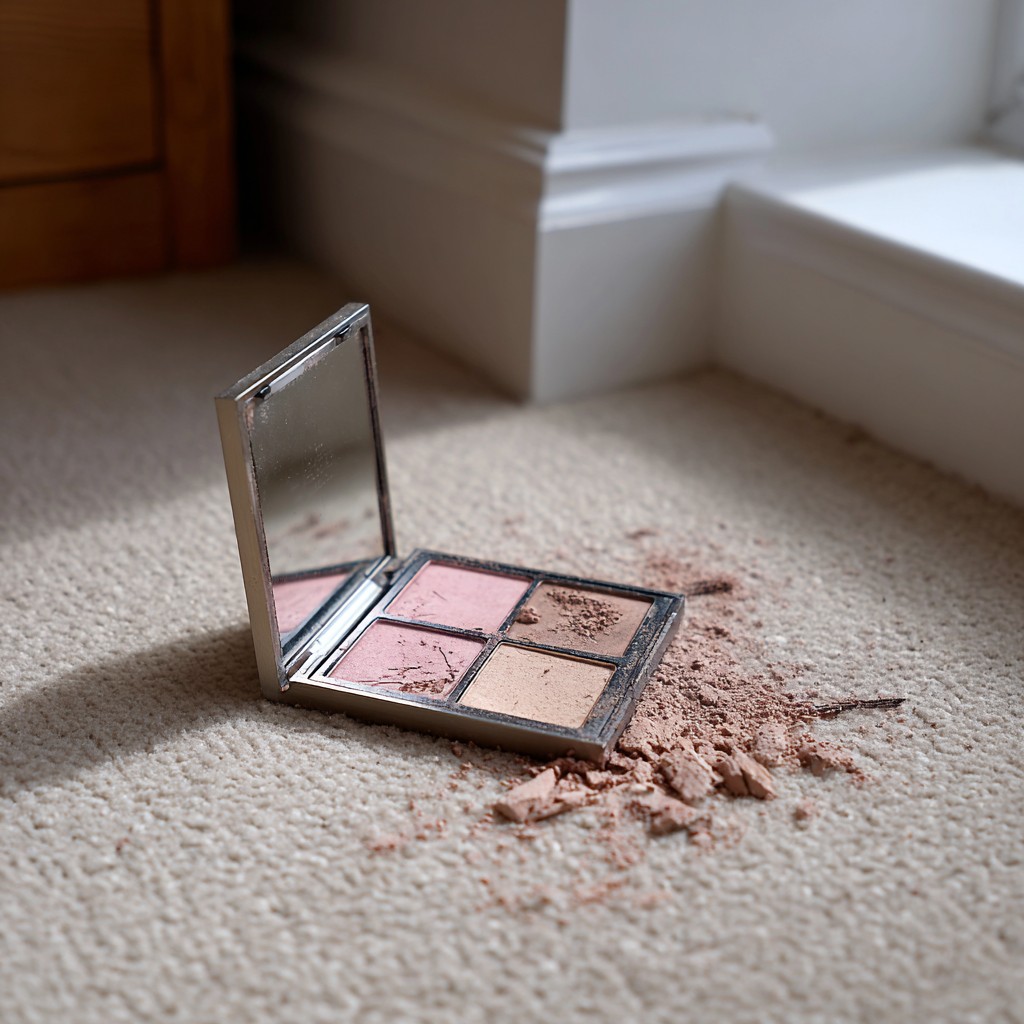
There is a specific, visceral horror that every makeup enthusiast knows in their bones – the slow-motion moment when a palette slips from the edge of a dressing table, spins gracefully through the air, and lands face-down on the carpet with a sound that can only be described as expensive. The pan shatters. The pigment explodes outward in a perfect radius of devastation. And there you are, concealer brush still in hand, staring at what was this morning a £45 highlighter and is now a shimmering crime scene on your bedroom floor.
This one’s for the beauty bloggers, the makeup artists doing home call-outs, the teenagers with hard-won pocket money invested in their first proper palette, and frankly anyone who has ever watched a haul video and thought “I need that” – and then dropped it. Makeup on carpet is one of the more technically demanding household stains, not because it’s impossible to address but because it encompasses such a wide range of product types, each with its own chemistry and each requiring a slightly different approach. Getting it wrong doesn’t just leave a stain – it can set one permanently. So let’s get into it properly.
Why Makeup Stains Are a Different Category Entirely
Most household stains are one thing: a liquid, a food, a dye. Makeup is simultaneously several things at once, which is precisely what makes it interesting from a cleaning perspective and deeply inconvenient from every other.
A single eyeshadow palette, face-down on carpet, might contain pressed powder pigments bound with talc and oils, shimmer particles held together with synthetic wax, and darker shades containing iron oxides or ultramarines – all with different chemical properties and different responses to cleaning products. Foundation adds a liquid or cream base to the equation. Lipstick is essentially a wax-and-dye delivery system. Blusher and bronzer are powder-based but often contain binding oils that resist water. Even a simple setting powder can leave a chalky residue that, if wetted incorrectly, turns into a paste that pushes deeper into the pile.
The broad categories to understand are powder-based products, cream and liquid products, and wax-based products – lipstick, lip liner, and certain cream eyeshadows. Each has a distinct approach. Getting the category right before reaching for anything is the single most important decision in this whole process.
Step One – The Counter-Intuitive First Move
Before any liquid, any cleaning product, or any cloth goes anywhere near a powder-based makeup spill, do nothing. Or more precisely, do one very specific thing: let it sit, and then remove the dry material first.
This is the instinct that most people override immediately, because the mess looks catastrophic and the urge to do something – anything – is overwhelming. But applying moisture to a dry powder spill before removing the loose pigment is how a surface mess becomes a deep stain. Water turns loose eyeshadow powder into a pigment-laden paste that gets worked into the carpet fibres with every subsequent touch.
Instead: take a clean, dry, stiff-bristled brush – a clean pastry brush works well, as does an old, clean makeup brush with some irony attached – and very gently sweep the loose powder toward the centre of the spill, lifting as much dry material as possible. Then use the nozzle attachment of a hoover on low suction to remove what remains, holding it just above the carpet surface rather than pressing it in. Only once the dry material is gone should any moisture be introduced.
For cream, liquid, or wax-based products, this dry-removal stage doesn’t apply in the same way – but it’s worth checking whether any powder was involved in a mixed spill before proceeding.
Tackling Powder-Based Makeup: Eyeshadow, Blusher, and Bronzer
Once the dry material has been removed, what’s left is a pigment shadow – a residual stain where the colourants have made contact with the carpet fibres. This is what needs treating.
Mix a solution of cold water and a small amount of washing-up liquid – the same basic first-response tool that appears throughout this series, for good reason. Apply a small amount to a clean white cloth and blot gently from the outer edge of the stain inward, replacing the cloth as it picks up colour. Do not rub. The goal at this stage is to lift the pigment, not redistribute it.
For highly pigmented products – and anyone who’s ever invested in a professional-grade or indie brand palette will know that modern pigments can be extraordinary in their intensity and their stubbornness – a follow-up treatment with a small amount of rubbing alcohol on a clean cloth can help break down the remaining colourants. Apply sparingly, blot carefully, and follow with a cold water rinse and thorough blotting dry.
Shimmer and glitter-heavy formulas present an additional challenge in the form of the metallic particles themselves, which can catch the light and remain visible in carpet pile long after the pigment has been addressed. A piece of sticky tape pressed firmly and lifted – not dragged – across the treated area can pick up residual shimmer particles that resist hoovering. It’s not glamorous, but it works.
Foundation, Concealer, and Liquid Products
Liquid and cream makeup products behave more like conventional wet stains, with the added complication of the pigment load they carry and, frequently, an oil or silicone base that requires more than water and washing-up liquid to fully address.
Blot up the excess immediately using a clean white cloth – the coverage payoff that made the foundation worth buying is now working directly against you, and the less of it that makes contact with the carpet fibres, the better. Cold water and washing-up liquid is again the starting point, but for oil-based or full-coverage formulas, a small amount of shaving foam – plain white foam, not gel – applied to the stain and worked in gently with a soft cloth can be surprisingly effective at lifting the product. It sounds eccentric but it’s a genuinely useful tool: the foam encapsulates the oily particles and makes them easier to blot away.
For set or dried liquid foundation – the stain you discovered the following morning rather than the moment it happened – rehydrating with cold water before treatment is essential. An enzyme-based stain remover applied after the initial cold water soak will help break down the organic components of the formula. Allow it to dwell for the time specified on the product, then blot out thoroughly and rinse with cold water.
Lipstick and Wax-Based Products: The Most Stubborn Offender
Lipstick on carpet is the scenario that makes professional cleaners earn their invoice, and the reason is simple: lipstick is a wax-and-dye product, and wax does not respond to water at all. Applying a water-based cleaning solution to a lipstick stain as the first step is essentially pointless – it will move the moisture around and potentially spread the stain, while leaving the wax component entirely undisturbed.
The correct first move is a dry-cleaning solvent or rubbing alcohol, applied to a clean white cloth and blotted gently onto the stain. This breaks down the wax binder and lifts the bulk of the colour. Follow with washing-up liquid solution to address the residual pigment and any oily components, then a careful cold rinse and thorough blotting dry.
The order of operations is non-negotiable here: solvent first, then detergent, then rinse. Reversing it – or skipping straight to a water-based approach – drives the wax deeper into the pile before it’s been broken down, and creates a stain that is substantially harder to shift than the original one.
A secondary concern with lipstick is the dye component, which in darker shades particularly – deep reds, plums, near-blacks – can be as demanding as any fabric dye. If colour remains after the wax has been addressed, a small amount of white vinegar solution applied and blotted can help. Manage expectations on very dark shades on light carpets: significant improvement is almost always achievable, but complete removal of a set, dark lipstick stain on a pale carpet is a job for professional extraction.
The Products That Are Actually Worth Keeping in Your Kit
Given that a makeup collection of any seriousness represents a meaningful financial investment, it makes sense to maintain a cleaning kit proportionate to the risk.
The essentials: plain washing-up liquid, white wine vinegar, rubbing alcohol, a dry-cleaning solvent such as Bissell’s cleaning solution or similar, and an enzyme-based stain remover. Clean white cloths – not printed, not coloured, as dye transfer from the cloth to a damp carpet is its own problem – and a soft-bristled brush for dry-powder removal. Shaving foam is an optional but worthwhile addition for cream and liquid foundations specifically.
Products to treat with scepticism: anything marketed specifically as a “makeup remover” for surfaces, which frequently contains the same optical brighteners and harsh solvents found in overclaiming miracle sprays, and which can strip colour from carpet dyes as readily as they strip mascara from a surface. The basic kit above covers virtually every makeup stain scenario if applied correctly.
When the Palette Wins
There are stains where the DIY toolkit has done its job and a residual shadow simply remains – a faint pink bloom where the blusher landed, a ghost of highlighter shimmer that catches certain light at certain angles. This is not failure. This is the honest limit of surface-level treatment on deeply set or heavily pigmented spills, and it’s the point at which professional hot-water extraction becomes the relevant tool.
The combination of a highly pigmented product, a light-coloured carpet, and any significant dwell time before treatment is the scenario most likely to land here. Catching spills within the first thirty minutes remains, as always, the most effective intervention available – more effective than any product in the kit, more effective than any technique, and considerably cheaper than any professional visit.
Drop the palette, yes. But drop everything else and deal with it first.